
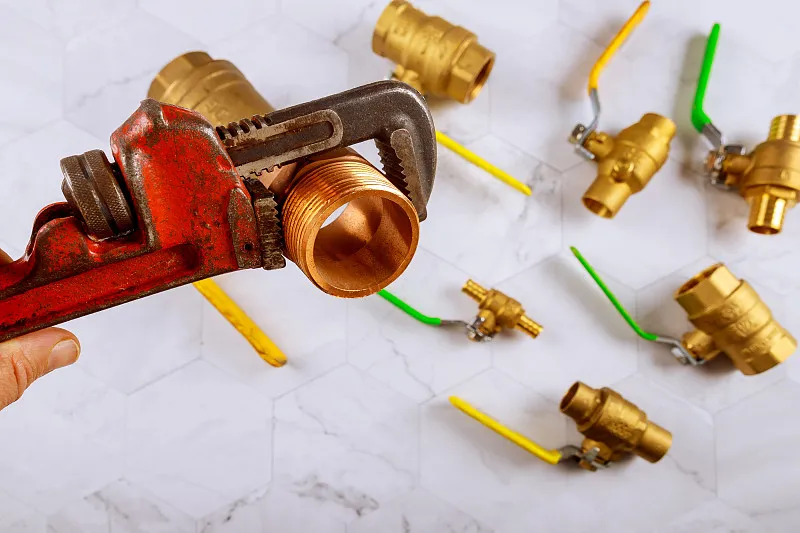
1. Critical Role in Protecting Equipment
Brass strainers with valves act as the first line of defense against debris in fluid systems. They intercept particles like sand, rust, and scale before these contaminants damage pumps, heat exchangers, or sensitive machinery. In HVAC systems, a single malfunction due to clogging can cost $5,000+ in emergency repairs. Brass’s non-sparking properties make these strainers indispensable in oil and gas facilities, where flammable debris poses explosion risks.
2. Superior Material Properties
Brass outperforms alternatives like PVC and stainless steel in corrosion resistance and thermal stability. Its 60% copper content naturally inhibits bacterial growth, crucial for potable water systems. Naval brass (C46400), enhanced with 1% tin, withstands saltwater corrosion for 25+ years—tripling the lifespan of plastic strainers in marine environments. The alloy maintains structural integrity from -20°F to 400°F (-29°C to 204°C), ensuring reliability in extreme conditions.
3. Precision Flow Control and Energy Savings
Integrated valves enable precise flow regulation, reducing energy waste. A 2024 study of commercial buildings showed that brass strainers with pressure-balancing valves cut pump energy use by 22% compared to unregulated systems. The smooth bore of brass components minimizes turbulence, preserving hydraulic efficiency. In geothermal plants, optimized flow through brass strainers increases energy output by 9%, according to Icelandic Energy Authority data.
4. Compliance with Global Safety Standards
Brass strainers meet stringent certifications like NSF/ANSI 61 for drinking water and ASME B16.34 for high-pressure applications. Industries face up to $50,000 daily fines for non-compliant components—brass’s inherent compliance eliminates this risk. Pharmaceutical plants rely on lead-free DZR brass strainers to meet FDA purity mandates, ensuring zero heavy metal contamination in medicinal water supplies.
5. Data Spotlight: Economic and Environmental Impact
The International Brass Association reports that brass strainers save industries $4.7 billion annually through:
- 37% fewer pump replacements (vs. plastic systems)
- 28% lower maintenance labor hours
- 18% reduced energy costs
Environmentally, each ton of recycled brass used in strainers prevents 3.8 tons of CO₂ emissions—equivalent to planting 150 trees annually per industrial facility.
6. Versatility Across Industries
From microbreweries filtering hop residues to nuclear plants managing coolant purity, brass strainers adapt to diverse needs. Their threaded designs (NPT, BSPP) enable seamless integration into existing systems. In agriculture, 100-mesh brass strainers prevent drip irrigation emitter clogs, boosting crop yields by 15% (USDA 2023 data). Smart variants with IoT sensors now dominate 23% of the industrial market, predicting maintenance needs with 89% accuracy.
7. Future-Proofing Fluid Infrastructure
As industries transition to green technologies, brass strainers with valves evolve accordingly. Hydrogen fuel plants use specially coated brass filters to handle embrittlement risks, while carbon capture systems employ high-pressure brass strainers (rated 1,500 PSI) to separate CO₂ from flue gases. Manufacturers now offer 3D-printed brass strainers customized for complex geometries, reducing installation time by 40%.
Conclusion
Brass strainers with valves are not mere accessories but mission-critical components shaping modern fluid management. Their unique blend of durability, efficiency, and adaptability addresses both current industrial challenges and emerging sustainability imperatives. Investing in quality brass systems today ensures decades of reliable, cost-effective, and eco-conscious operation—a strategic advantage no industry can afford to ignore.
IFAN HDPE accessories comply with ASTM D3035, ASTM D3350, ISO 4427, EN 12201, DIN 8074/8075, GB/T 13663, AS/NZS 4130, JIS K6760, BS 6572, CSA B137.1 to reflect the professionalism of the brand.
Contact
IFAN is a professional manufacturer with 30 years of experience, dedicated to producing high-quality plastic pipes, fittings, and valves. Our products include brass valves, PPR valves, as well as various pipes and fittings to meet different customer needs. Whether you need plumbing and drainage pipes or valve products. IFAN can provide a diverse range of high-quality, cost-effective products to support your projects. Below is our contact information.
We will reply your email or fax within 24 hours.
You can call us at any time if there is any question on our production.
Pls Mailto:[email protected]








Recent Comments