
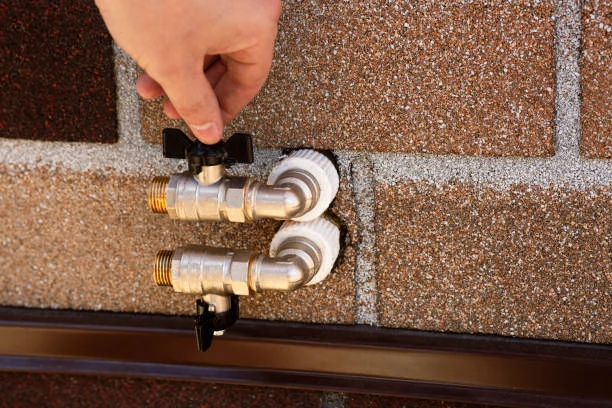
1. Traditional Valves Enter the Smart Era
Lockable Ball Valves are no longer limited to their basic function. Thanks to new technologies, manufacturers are transforming them into smart components. By integrating sensors, communication modules, and connected locking systems, they create solutions capable of communicating with home automation, industrial, or municipal networks. Fluid management becomes more precise, safer, and fully controllable remotely.
2. Embedded Sensors: Real-Time Monitoring
Engineers are adding pressure, temperature, and flow sensors directly to Lockable Ball Valves. These sensors transmit instant data to monitoring platforms. Operators can thus monitor the valve’s status, detect anomalies, and react quickly in the event of abnormal fluctuations. This continuous monitoring prevents unnecessary interventions and enhances the overall reliability of the system.
3. Automation and Remote Control
With the integration of electric or electromagnetic motors, Lockable Ball Valves become fully remote-controlled. Network managers control opening or closing from a mobile app, computer, or centralized monitoring interface. They also program automatic scenarios: closing in the event of a detected leak, opening according to a time slot, or emergency shutdown in the event of overpressure. This intelligent control offers unparalleled flexibility and responsiveness.
4. Enhanced Security with Digital Locking
The traditional locking mechanism is also evolving. Manufacturers are sometimes replacing the physical key with a digital system or secure badge control. Some valves use RFID or Bluetooth technology to activate unlocking only in the presence of an authorized operator. This intelligent locking protects installations against human error or unauthorized manipulation. In sensitive areas, this security represents a decisive advantage.
5. News: A town pilots smart valves in its water network
The municipality of Montargis has launched a pilot project to modernize part of its drinking water network with connected Lockable Ball Valves. Technical Services Manager Julie Perrier explains: “We installed twenty smart valves at strategic points. They communicate with our central system and automatically respond to leaks or pressure drops.” Since their implementation, the municipality has reduced water losses by 18% and avoided several service interruptions. This success has prompted the municipality to extend the installation to the entire network within two years.
6. Predictive Maintenance Using Artificial Intelligence
The smart Lockable Ball Valves learn from their operation using artificial intelligence algorithms. These tools analyze opening and closing cycles, detect abnormal behavior, and predict component wear. Maintenance teams receive alerts well before a malfunction occurs. This anticipation limits breakdowns, extends the lifespan of installations, and improves intervention planning.
7. Integration with home and industrial automation systems
Manufacturers ensure full compatibility with standard automation protocols: Modbus, BACnet, KNX, and Zigbee. Thanks to this interoperability, Lockable Ball Valves integrate seamlessly into smart buildings, connected factories, or modernized agricultural farms. They communicate with other devices—leak sensors, smart meters, pumps—and become part of a seamless and responsive ecosystem.
8. Towards sustainable and autonomous network management
The intelligence embedded in Lockable Ball Valves paves the way for fully autonomous management of fluid networks. The valves detect, analyze, decide, and act without human intervention, while providing detailed reports to operators. This approach reduces energy consumption, avoids waste, and improves overall facility safety. By combining mechanical robustness and digital innovation, these valves are redefining the standards of flow management for decades to come.
IFAN PEX fittings meet ISO 15875, GB/T 18992, DIN 16892, ASTM F877/F2788, BS 7291, BS EN ISO 15875 and CSA B137 standards for optimum quality and compatibility.
Contact
IFAN is a professional manufacturer with 30 years of experience, dedicated to producing high-quality plastic pipes, fittings, and valves. Our products include brass valves, PPR valves, as well as various pipes and fittings to meet different customer needs. Whether you need plumbing and drainage pipes or valve products. IFAN can provide a diverse range of high-quality, cost-effective products to support your projects. Below is our contact information.
We will reply your email or fax within 24 hours.
You can call us at any time if there is any question on our production.
Pls Mailto:[email protected]










Recent Comments